
Precision Crankshaft Grinding for Heavy Diesel Engines
Franklin Engineering Services provides specialist crankshaft grinding for heavy diesel engines. Main and big-end bearing journals reground to precise undersize tolerances, with the surface finish and geometry required for a reliable, long-lasting rebuild.

Restoring the Heart of a Heavy Diesel Engine

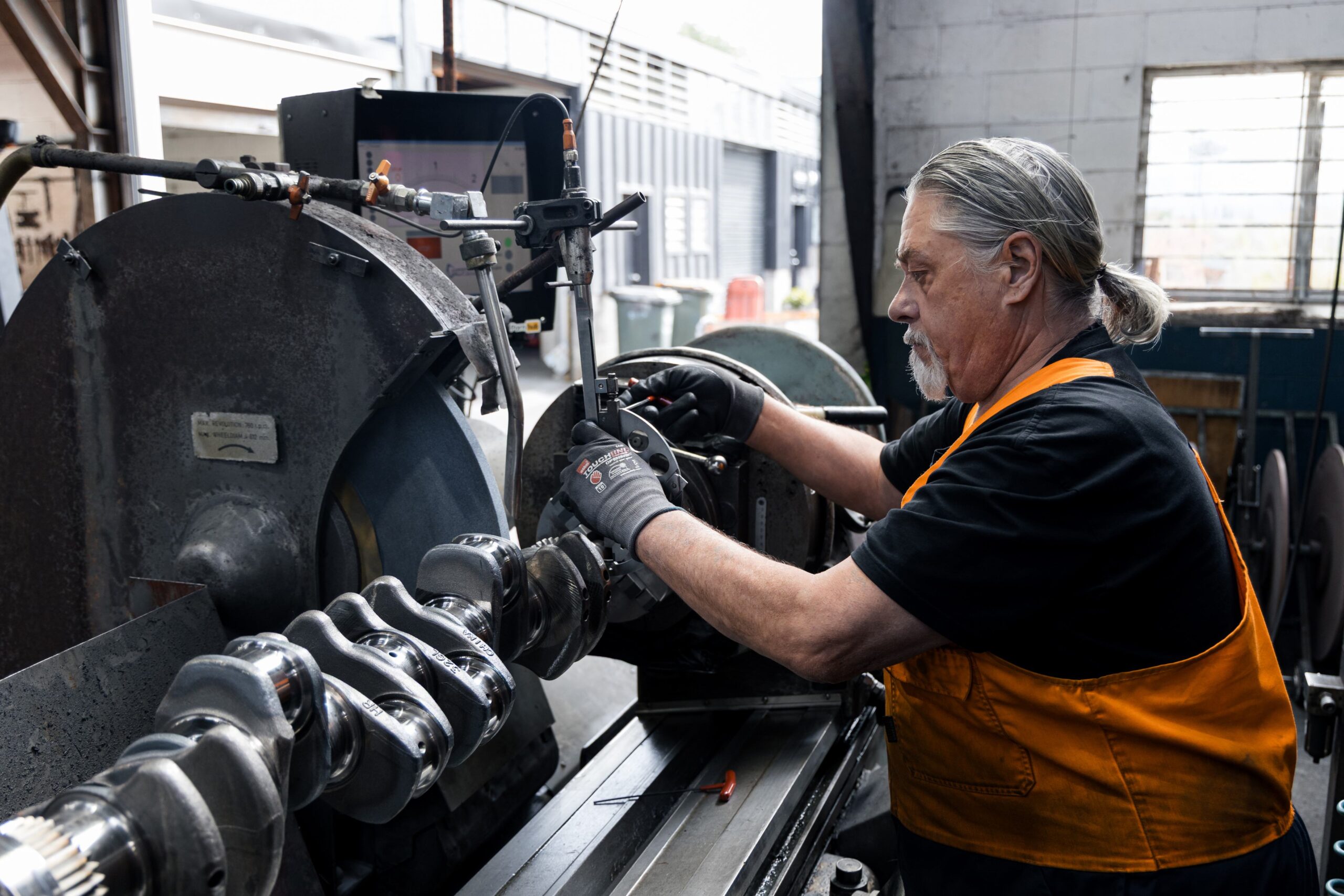
The crankshaft is the backbone of a diesel engine. It converts the reciprocating force of the pistons into the rotational power that drives the vehicle or machine, and it does this at continuous high load, supported at its main and big-end bearing journals by a thin film of pressurised oil. When that oil film breaks down through contamination, extended service intervals or a lubrication failure, the journals wear or score. When wear exceeds manufacturer tolerances, the crankshaft needs to be ground.
Crankshaft grinding is the process of machining the worn main and big-end journals back to a precise undersize dimension, removing the damaged surface and restoring the correct geometry and surface finish for the bearing to run on. Undersize bearings are then fitted to match the reground journals, restoring the correct oil clearances the engine requires. Done correctly to the right tolerances, a reground crankshaft performs reliably and gives the rebuilt engine a sound foundation for years of service. Done poorly — or skipped entirely — bearing failure and premature engine wear are the predictable result.
Franklin Engineering Services has been grinding crankshafts in-house for decades. The workshop has a dedicated crankshaft grinding machine capable of handling the full range of heavy diesel crankshafts, from truck and plant engines through to large marine and industrial units. It is a capability that most workshops send out, but at Franklin Engineering Services it stays in the building, giving the team full control over quality, timing, and the outcome of each job.
Crankshaft Grinding and Journal Reconditioning Across All Heavy Diesel Platforms
Franklin Engineering Services grinds crankshafts across the full range of heavy diesel engine platforms, from standard passenger-car-derived diesel engines through to large-bore truck, marine and industrial crankshafts. The service covers main and big-end journals as a standalone job or as part of a complete engine reconditioning rebuild.
COMMON APPLICATIONS:
- Main bearing journal grinding
- Big-end (crankpin) journal grinding
- Thrust face reconditioning
- Crankshaft straightening assessment prior to grinding
- Journal build-up via metal spraying followed by precision grinding (for severely worn journals)
- Crankshaft grinding as part of a complete engine recondition
INDUSTRIES SERVED:
- Heavy Transport & Haulage
- Earthmoving & Civil
- Marine & Ferry Operations
- Agricultural & Farming
- Generators & Standby Power
Measured, Machined, and Verified Crankshaft Grinding Under One Roof
Every crankshaft grinding job at Franklin Engineering Services starts with measurement. The journals are checked for wear, out-of-roundness, taper, and surface condition before any grinding begins. This establishes the correct undersize to grind to and identifies any pre-existing issues, such as cracks or bending, that need to be addressed first. Getting this assessment right is what separates a grinding job that gives years of service from one that doesn't.
The grinding itself is carried out on a dedicated crankshaft grinding machine, set up for the specific crankshaft dimensions and the required undersize. Each journal is ground to the correct geometry — roundness, taper and surface finish — then polished to the Ra value required for the bearing type. Franklin Engineering Services works to manufacturer undersize specifications throughout, so the finished crankshaft is ready to be matched with the correct undersize bearings and assembled with confidence.
The crankshaft grinding process at Franklin Engineering Services:
Assessment & Measurement
The crankshaft is cleaned and each journal measured for diameter, roundness, taper and surface condition, determining the correct undersize and identifying any issues to resolve before grinding
Straightness Check
The crankshaft is checked for bending across its length. Where straightening is required before grinding can proceed, this is carried out at this stage.
Journal Grinding
Main and big-end journals are ground to the specified undersize on the crankshaft grinding machine, working to the geometry tolerances required for the engine platform.
Polishing & Surface Finish
Ground journals are polished to the correct surface finish (Ra) — ensuring the bearing surface is smooth enough to maintain the oil film that protects the journal and bearing in service.
Final Inspection & Sizing
Each journal is measured against the target dimensions and recorded. The crankshaft is signed off with the undersize dimensions documented, so the correct bearings can be specified for the rebuild.
Franklin Engineering Services has been grinding crankshafts in-house for decades across every major heavy diesel engine platform, from truck and plant engines to large marine and industrial units that most workshops simply cannot handle..

Talk to Us About Your Crankshaft Grinding Requirements
Tell us the engine make and model, what you're seeing — bearing failure, oil pressure loss, knocking — and the Franklin Engineering Services team will assess the crankshaft, confirm what grinding is required and come back with a clear picture of what's involved.
Frequently Asked Questions
What is crankshaft grinding and when does a crankshaft need it?
Crankshaft grinding is the precision machining of the bearing journals — the round surfaces that the main and big-end bearings run on — to remove wear, scoring or surface damage and restore them to a precise undersize dimension. A crankshaft needs grinding when journal wear or surface damage exceeds the manufacturer's tolerance for that engine. The typical triggers are bearing failure, low oil pressure, engine knock, or a teardown inspection that shows journals are worn beyond spec. Franklin Engineering Services can measure the journals and give a clear recommendation on whether grinding is required and what undersize to target.
How do I know what undersize to grind to?
The correct undersize is determined by measuring the journals and identifying the smallest standard undersize that will clean up the worn or damaged surface across every journal. Common undersizes are 0.25mm, 0.50mm, 0.75mm and 1.00mm undersize, following the manufacturer's published bearing sizes for that engine. FES measures every journal before grinding and documents the dimensions — so the correct undersize bearings can be specified for the rebuild.
What happens if a journal is too worn to grind to a standard undersize?
If a journal has worn beyond the last available standard undersize, or if there is localised damage that cannot be cleaned up by grinding alone, metal spraying is the solution — building the journal back up with sprayed material, then grinding it to the correct dimension. FES carries out both metal spraying and crankshaft grinding in-house, so the entire process can be handled as a single job without the crankshaft leaving the workshop.
Should a reground crankshaft be balanced afterwards?
Yes — particularly where metal has been removed unevenly across the journals, or where the crankshaft is part of a rebuild with new pistons and connecting rods. Grinding changes the mass distribution of the crankshaft, and for a quality rebuild the crankshaft should be balanced after grinding. FES has in-house balancing capability, so both the grinding and balancing can be carried out as part of the same job.